
Home » Our approach » Factory 4.0
A factory built for repeatable production
Factory 4.0
A modern factory
At Doeko, automation forms the basis of how we produce high-tech components, modules and systems. Our factory is set up as an integrated production environment in which ERP, machines, storage, quality control and routing are connected.
This allows parts to move through different process steps in a controlled flow, while quality remains stable throughout the full route from first operation to assembly. This setup makes it possible to produce complex high-tech products repeatably within scalable production flows.
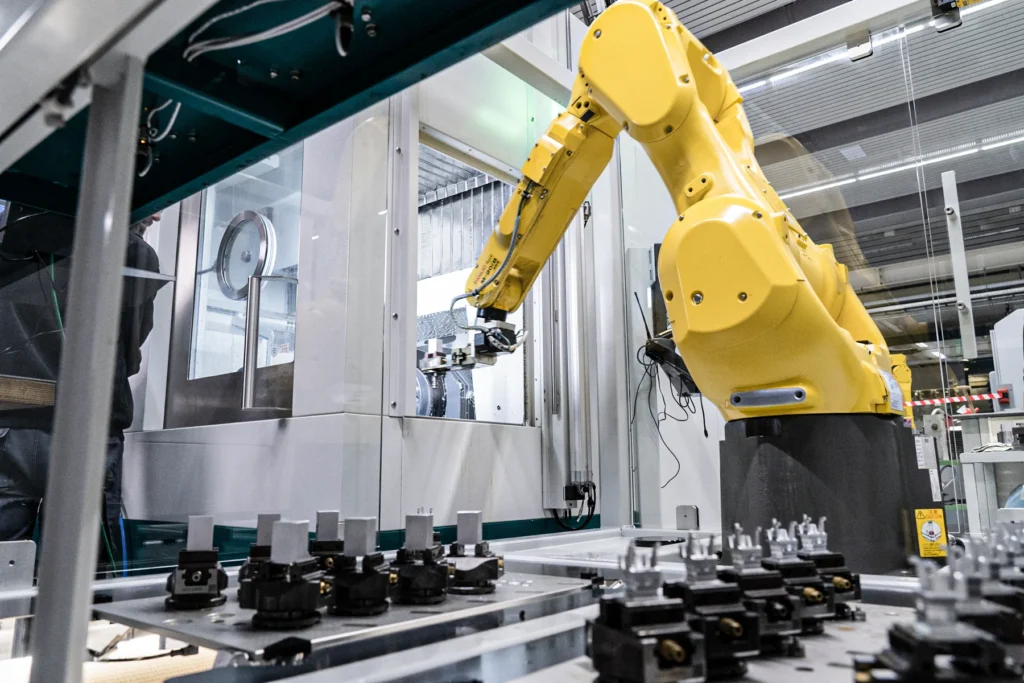
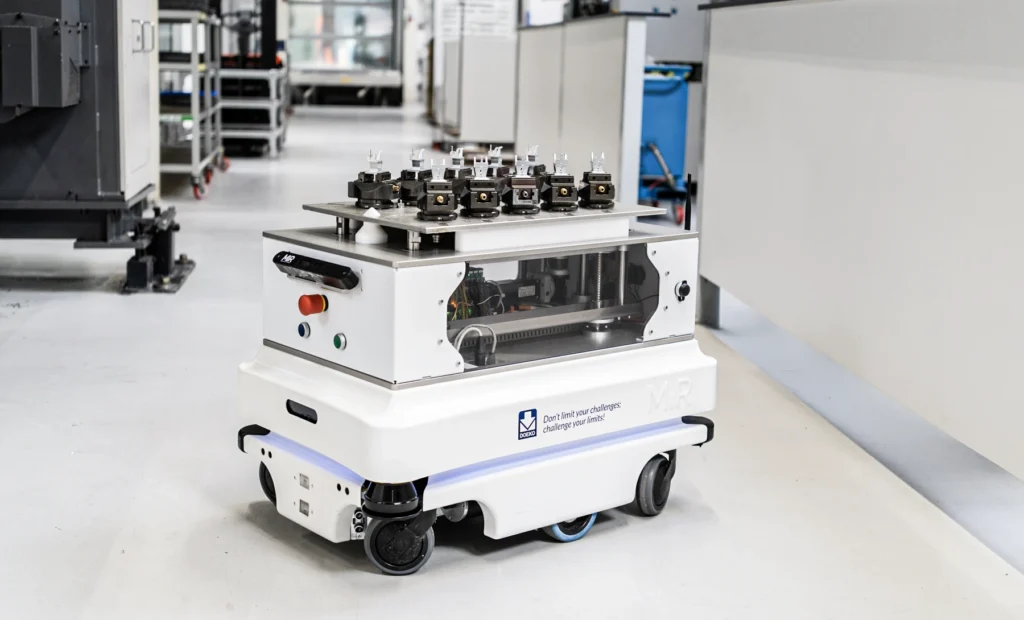
Automated production
Why is automation important?
Many high-tech components consist of multiple operations that influence one another. When these steps are carried out separately, variation can occur in dimensions, workholding and lead time. By automating and connecting production processes, we create a controlled routing in which parts remain part of one stable production flow.
Within this approach, we create what we call: quality on repeat.
- Keep tolerance stack-ups stable
- Combine multiple process steps in a controlled way
- Scale components repeatably towards series production
- Automatically check quality during the process
This keeps parts suitable for use at module and system level within high-tech environments.
Our approach
Automation at Doeko
At Doeko, automation is not about robots on their own, but about the right production route for the product. Sometimes a part requires one stable and efficient process. In other cases, multiple operations, checks and logistics steps are needed to achieve the right result.
That is why we develop most of our automation ourselves. Our own mechatronics team designs and realises the connection between machines, robots, logistics and quality control. We use proven technology from suppliers such as Fanuc, but develop the integration within our factory ourselves.
This creates a production environment in which we can determine the best route for each product: a dedicated automated cell for repeatable production, or a connected route through central storage, AGV transport and robot cells for more complex products with multiple process steps.
Automated production around one process
Not every product has to move through the full automated routing of the factory. For products that mainly require one type of operation, a dedicated machine or robot cell may be the best solution.
Within Doeko, several machines have their own automation for product handling, pallet changing or unmanned production. This allows us to produce parts efficiently and repeatably without always routing them through central storage.
This approach is suitable for products that need to be produced in larger numbers, for repeated operations or for parts where fast handling and stable positioning are critical. Follow-up steps such as cleaning, testing or cleanroom packaging can still remain part of the overall production process.
This means we do not automatically choose the most extensive route. We choose the production route that fits the function, quality requirements and required output of the product.
Automated routing through the factory
For more complex products with multiple operations, Doeko offers an integrated automation structure. Using standardised machining pallets, central storage and AGV transport, parts can be automatically moved to different machines and process steps.
This approach is particularly strong when products require multiple machining steps, when tolerance stack-ups are closely connected or when in-process quality control is important. Parts remain part of one controlled route through the factory.
Central storage forms the logistical heart of this setup. The AGV transports pallets between storage, machines and robot cells. Automated quality measurements can also be integrated into this environment. When a measurement detects a deviation, the process can be interrupted so that errors are not repeated within a series.
This way of working makes our factory suitable for complex high-tech components where repeatability, routing and process control determine the final result.
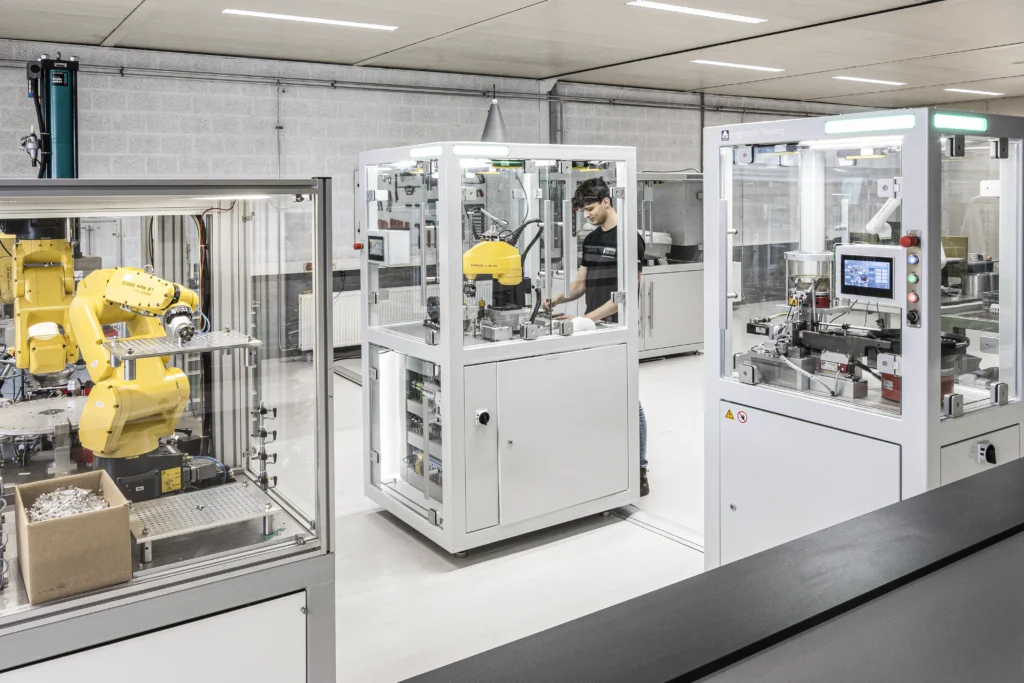
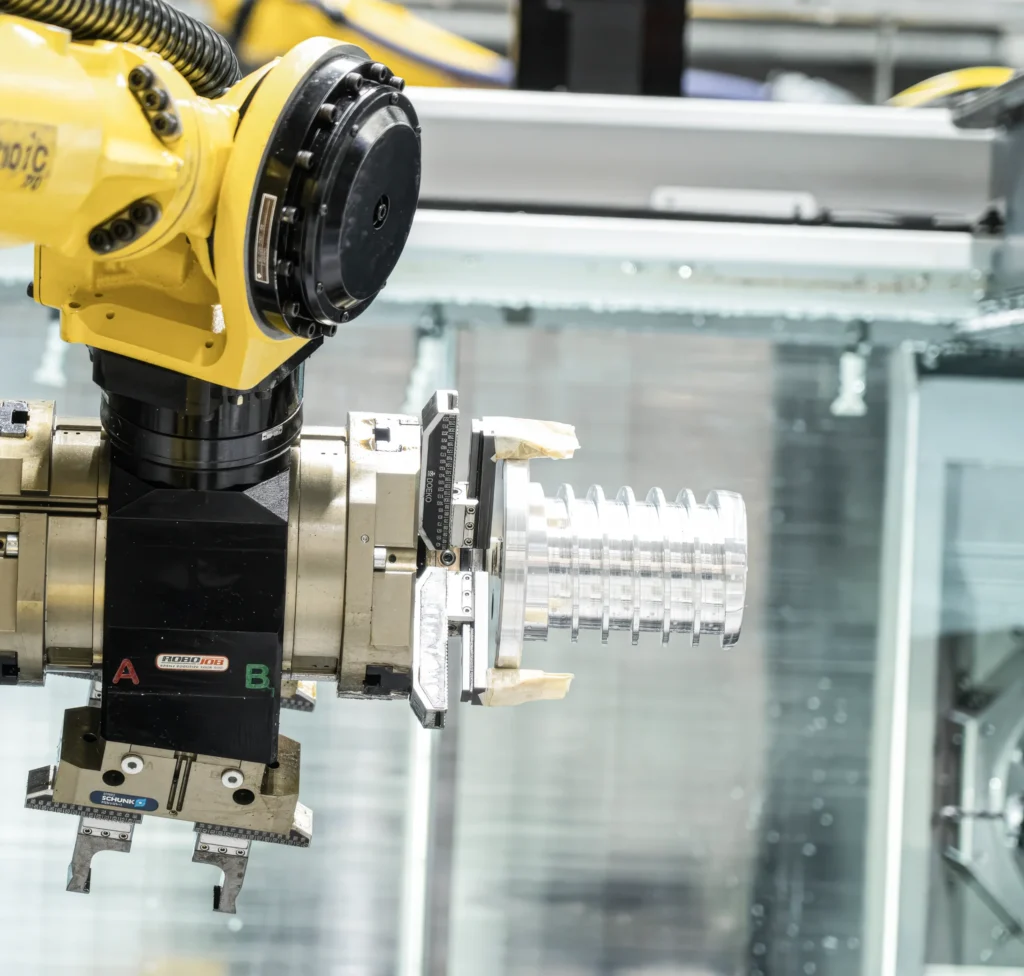
From data to production
Thinking from modern systems
Our production environment is controlled, so tolerances remain stable during machining and inspection. In addition, we work with ERP and MES systems and are prepared for Model-Based Definition, where product information can be linked directly from the 3D model to production and quality control.
Want to know more about the technology behind our automation? View the page about automation.
Use our factory for your product
Factory 4.0 as the basis for scalable production
By combining ERP and MES systems, central storage, AGV transport, robot cells and standardised machining pallets, automation at Doeko is not a separate addition to the production process. It is an integral part of the factory. This allows parts to be routed automatically between multiple process steps, while quality remains manageable throughout the full route from component to module or system.
This approach makes it possible to produce complex products repeatably within scalable production environments.
Frequently asked questions
Practical questions and answers
How does the automated routing in Doeko’s factory work?Hoe werkt de geautomatiseerde routing in de fabriek van Doeko?
Doeko uses central storage, where machining pallets are stored centrally. Via an AGV, trays with pallets are automatically moved to the right machine, robot cell or process step. This allows products to move through multiple operations in a controlled way within the factory.
Can Doeko work with Model-Based Definition?
Yes. Doeko can work with Model-Based Definition when customers use it. Product information from the 3D model can be used to better align production and quality control. This is especially useful for complex parts with a large amount of dimensional and tolerance data.
How does Doeko ensure consistent quality in an automated production environment?
Doeko ensures consistent quality by combining automation, standardised pallets, in-process inspection and a controlled production environment. This makes repeated process steps more stable and allows deviations to become visible earlier. Automation therefore supports not only speed, but above all repeatability.